This Is Not A Legal Record logo

This Is Not A Legal Record

Archives

This Is Not A Legal Record This Is Not A Legal Record

Archive

Resetting the Arc

In Dobbs v. Jackson Women’s Health, the Roe v. Wade decision protecting the right to abortion has been completely overturned by justices who, when asked about Roe in their confirmation hearings, professed deep respect for the principle of stare decisis (stand by things decided). Unlike prior reversals of Court precedent, this one eliminates individual rights rather than expanding them.1

The result is a catastrophe for women, for anyone who might seek the medical care abortion provides. It fetters them. It will upend their lives, make them deeply unfree. They will be bound against their will into enacting the state’s conception of an individual life. Thus, many will be forced into radically different lives from the lives they wanted to live. Because abortion, as a medical procedure conducted by professionals, saves lives, many people will die. Some will be murdered (because men will kill partners carrying their offspring). And children will be born against their parents’ will.

I was not born against my mother’s will. (I do not know, and may never know, what was my father’s will.) I can’t speculate what my mother’s will was in relinquishing me to a Catholic adoption agency. I do know that she lacked the resources and support necessary to raise me. In consequence of an event for which she cannot be held to blame—she was impregnated; she did not impregnate herself2—she handed away to that agency her first and only child, whom she never for a single day failed to think of, whom she searched for with no success, who found her and learned her story and that of thousands of others who relinquished their children because they had no other choice, enduring a lifelong anguish that religious conservatives in the United States are, right now, jubilant about seeing inflicted, again, nearly fifty years after the United States Supreme Court said this is not consistent with our ideals and it is not consistent with our grounding law.

To realize God’s Heaven on Earth we must force births. To realize God’s Heaven we must think of the millions of childless couples who will have a chance to call their own the babies so forced into existence. And to realize God’s Heaven we must mount “a massive national marketing campaign to elevate the sacrificial love and benefit for heroic women and girls who choose adoption.”

Free post
#13
June 27, 2022
Read more

Genetic Supremacy

In October 2021 Real Life, an online magazine about “living with technology,” published “The Parent Trap: How DNA Testing Complicates the Queer Family,” which begins by noting the appearance, within LGBTQ+ parenting groups, of Severance Magazine. Severance calls itself “a magazine and community for people who’ve been separated from their biological family,” a broad category that includes those who have been adopted, fostered, trafficked, conceived through reproductive technologies like surrogacy and gamete donation, and born through misattributed paternity. There is great diversity of experience both within the broad category of the biologically (or genealogically) severed, and within each of those subcategories. Nevertheless, Severance is devoted to the idea that within this diversity there is sufficient commonality of shared experience to warrant creating a safe and inclusive space for reflection, discussion, community building, and advocacy.

Alexandra Kimball and Tamara Lea Spira, authors of “The Parent Trap,” will have none of it:

The fact that Severance could try to group “people who have been separated from biological family” all together, as if the experience of being raised apart from a genetic relative trumped all the other circumstances, speaks to the rising power of genetic discourse in our culture and the idea that the “genetic family,” measured by DNA, is the norm against which all forms of family should be judged. 

Severance’s mission statement, in fact, nowhere commits itself to the proposition that biological severance “trump[s] all the other circumstances,” nor does it employ the phrase “genetic family,” allegedly “the norm against which all forms of family should be judged.” Indeed, Kimball and Spira’s enclosure of “genetic family” in quotation marks disingenuously implies that Severance does use this phrase.

Free post
#12
June 16, 2022
Read more

Genealogical Parents

In talking about adoption online, I am repeatedly reminded that many people find it unintuitive to criticize infant adoption by strangers simply because it creates genealogical bewilderment. Or, to qualify a bit, people can understand what is bad about what we might call “medical bewilderment:” the loss of family health history, which can inform everything from life habit formation to the decision to undergo early screening for cancers and chronic health conditions. Family health histories can inform the decision to bear children. And of course, those offspring inherit medical bewilderment from their medically bewildered parents. But many people believe that even the disadvantages of medical bewilderment are offset by the boons of removing children from their original families, beset by whatever crises, and placing them in “loving” and materially better circumstanced households. (Never mind that this type of accounting presumes that the advantages of the latter must come at the cost of genealogical bewilderment.)

Beyond medical bewilderment, however, the idea of genealogical bewilderment spawns—well, bewilderment. Countering this is a large task I keep returning to in these posts. This time I want to look at one way skepticism about the harm of genealogical bewilderment finds expression: in the idea that one’s biological parents—mere contributors of the germplasm for one’s formation—aren’t “true” parents at all. I am critical of this attitude, but in a curious way, I find that I agree with an idea that underlies it: the idea that parenthood morally demands some degree of social connection to one’s offspring.

I have listened to advocates of ending secrecy in the fertility industry: those who argue that anonymity in gamete “donation” (typically, the selling of gametes to cryobanks) is unethical. And I am especially interested in the critiques made by donor-conceived people, many of whom have known since early childhood that they were conceived that way, while others came to the knowledge much later, either through an announcement from their families or through the use of genetic genealogy companies like Ancestry and 23andMe. The industry they are criticizing eschews calling gamete donors “parents,” preferring to frame donation as selfless, and maybe a little heroic—playing up a comparison with donating blood or bone marrow or organs. The problem with these comparisons is that assisted reproduction with donated gametes is not a curative intervention. And assisted reproduction with anonymously donated gametes has the unique feature, relative to the other types of cell, tissue, and organ donation, of producing a human being. And that human being is genealogically bewildered.

To be genealogically bewildered is not to know who one’s parents are. This is not sentimentalism; it is how we talk about the continuity of biological life. Think of how biology classes standardly describe Mendel’s experiments with cross-breeding pea plants.

Free post
#11
May 31, 2022
Read more

Our Target is Secrecy

A lesbian couple in Oklahoma married and decided to have a child. One of them conceived with sperm from a “known,” i.e. non-anonymous, donor. Two years later their marriage began to break up. During the divorce proceedings, the judge struck the name of the “non-gestational” parent from the child’s birth certificate, on the grounds that she had never formally adopted the child. In place of her name, the judge said, would go that of the donor. The non-gestational parent is attempting to appeal the case, with likely assistance from the Oklahoma ACLU. Her argument is that the courts have already recognized the right of non-gestational parents in LGBTQ+ families to have their names listed on their children's birth certificates, and to do otherwise is to fail to grant LGBTQ+ couples the same marriage protections granted to straight couples.

Like the child at the center of this battle, I had my parentage legally rewritten. I see that although the child is at the heart of the fight, he is not at the heart of the story, which is told as one about LGBTQ+ marriage and parental rights. My genealogical origin was hidden by a legal decree that redefined my legal family identity. I therefore pause over a fact about battles like the one in Oklahoma that standard accounts generally ignore: that given the birth certificate’s combination of of roles, to determine parental rights over a person entails a determination, or redetermination, of that person’s family identity.

I pause because, as one whose parentage was legally rewritten, I am obsessed with the fact that the legally binding document of my parentage is titled a “Certificate of Live Birth,” despite listing the names of two people with no involvement in my birth. Like others barred access to the original versions of their birth certificates, I see the altered version as a legal fiction and a genealogical lie. To call it a lie is to say that it misrepresents the facts. The fact that it misrepresents is my genealogical origin. But my birth certificate truthfully states a different fact: my adoptive parents’ legally binding parentage. In my case—and in that of the child in Oklahoma—the birth certificate cannot truthfully represent both sets of facts.

What should a birth certificate truthfully record?

Free post
#10
May 22, 2022
Read more

Cutting Ties, Finding Links

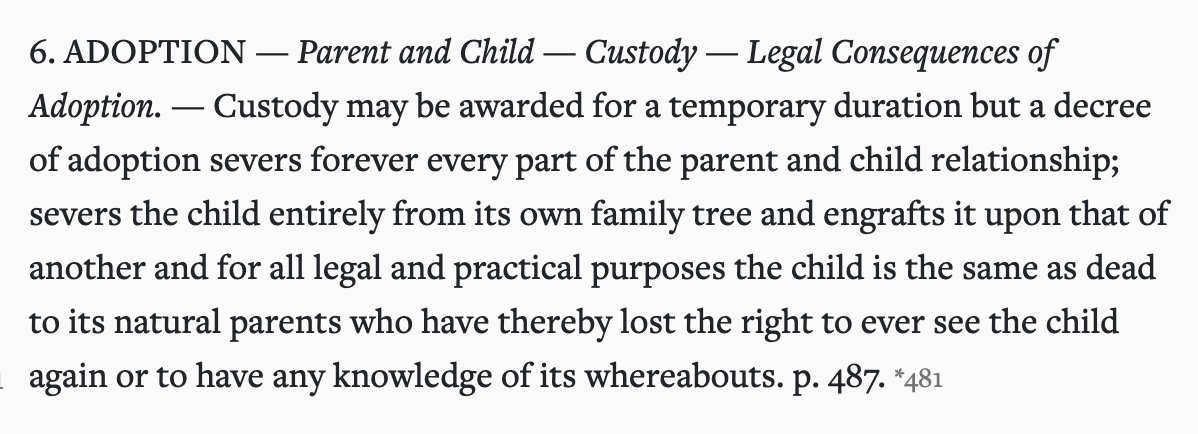
I began speaking openly about adoption roughly five years ago. I used Twitter to make connections with others who were also relinquished in infancy and adopted, in closed proceedings, into strangers’ families. I learned of the work of activists devoted to the goal I cared about above all: repealing laws, state by state, that bar adoptees from access to their own birth records. Through dialogue with others who share my history and who also criticize what I call the Regime of Secrecy that has been the paradigm of adoption in the US since the 1940s, I have claimed my adoption as a core part of my identity. And through ongoing dialogue with these adoptees and activists, I have begun to broaden my critique. For example, I have come to the belief that it is not enough to demand the end of secrecy in adoption, but we must challenge, and ultimately abolish, the conception of adoption that is hegemonic in the United States and other industrial nations: that it is a mechanism for creating and augmenting families. People who adopt from a desire to “have a child” will, in general, be motivated to deemphasize the importance of the adoptee’s pre-adoption history, if not erase it entirely. And existing institutional arrangements in most states are explicitly designed for lifetime erasure, as stated by the Indiana Court of Appeals in the case of Bryant v. Kurtz (1963):

What moved me five years ago lives in me still: an intense anger at the total disregard, embodied in the idea of stranger adoption as family creation and lifetime erasure, for the adoptee’s right to share in what every kept person takes for granted: their genealogy, and their knowledge of the people within that genealogy who may be dead “for all legal and practical purposes,” but are in fact not dead at all.

In the years since, my online presence as a critic of adoption in the US has connected me to a much broader range of people, with life histories very different from my own, including:

Free post
#9
May 19, 2022
Read more

Genesis

So much of the debate over adoptees’ right to knowledge of their genealogies appears to turn on the question: What good is it to have that knowledge? Is it essential to a complete life? Is its absence a disadvantage? And what data can we gather about adoptees, as a demographic group, to help decide such questions?

Adoptees frequently cite the published finding that “the odds of a reported suicide attempt were ∼4 times greater in adoptees compared with nonadoptees (odds ratio: 4.23).” Other findings suggest that adolescent adoptees are overrepresented among both those who come into contact with mental health professionals and, more specifically, those who are diagnosed with a “disruptive behavior disorder,” the odds for adoptees being roughly double that of their non-adopted counterparts. These findings suggest that being adopted carries adverse consequences for mental well-being, but it would be too quick to conclude that lack of genealogical knowledge is an important factor. Social stigma, for example, is a separate factor that plausibly contributes to adoptees’ difficulties with living among the kept.

One kind of evidence critics of adoption cite, in arguing that lack of genealogical knowledge is harmful, are personal reflections from interviews with adoptees.1 Adoptees have movingly testified to the power of gaining this information. But studies that cite personal testimony are open to the criticism that they are self-selected, hence not necessarily representative of broad commonalities among adoptees as a whole.

Indeed, if we keep our ears open, we will hear adoptees who feel alienated from what can seem like a chorus of voices chanting the many blessings of search and reunion. In fact, not all adoptees desire to search. Not all adoptees who criticize plenary adoption, or advocate its abolition, desire to search. Not all adoptees who feel no affection for their adoptive parents desire to search. To insist that searching meets a deeply rooted need can sound, to some adoptees, like an accusation: if you do not feel that need, you are likely “fogged” and self-deceived.

Free post
#8
May 12, 2022
Read more

"The Mind That Would String Those Words Together"

It appears that liberals and progressives are beginning to perceive a connection between abortion politics and adoption politics. The leaked draft opinion overturning Roe v. Wade contains a footnote including the now-notorious phrase: “the domestic supply of infants relinquished at birth or within the first month of life and available to be adopted.” Here is a sampling of responses from liberal and progressive Twitter:

Twitter avatar for @BCDreyer
Benjamin Dreyer @BCDreyer
I can’t get past the horror of “domestic supply of infants.” Consider the mind that would string those words together.
9:06 PM ∙ May 7, 2022
19,233Likes3,113Retweets
Twitter avatar for @tnicholsmd
Taylor Nichols, MD @tnicholsmd
When a Supreme Court Justice writes that abortion should be outlawed for the purpose of generating an increased “domestic supply of infants” to meet needs of parents seeking infants to adopt, we aren’t exaggerating by stating that they want you to be brood mares for the state.
2:35 PM ∙ May 7, 2022
19,003Likes4,838Retweets
Twitter avatar for @BFriedmanDC
Brandon Friedman @BFriedmanDC
Feels like this has been largely overlooked, but Alito's draft Supreme Court opinion on abortion uses the phrase "domestic supply of infants." It's real, on page 34. DOMESTIC SUPPLY OF INFANTS.
Image
1:58 PM ∙ May 6, 2022
36,698Likes14,137Retweets
Free post
#7
May 8, 2022
Read more

Why Is That Controversial?

Politico published on May 2 a leaked draft opinion, written by Justice Samuel Alito, overturning the 1973 Roe v. Wade decision guaranteeing constitutional protection of the right to abortion. I was among the adoptees to voice my horror at the news, inevitable though we knew it was. But, since my bodily autonomy is not at risk, what is my stake in this? What does my perspective add to those of the millions of people who may soon find that it is a crime in their states to take care of their own bodies?

In early December, Justice Amy Coney Barrett wondered aloud in oral arguments in Dobbs v. Jackson Women’s Health whether the availability of relinquishing one’s offspring for adoption might obviate the need to seek an abortion:

So petitioner points out that in all 50 states, you can terminate parental rights by relinquishing a child after [birth], and I think the shortest period might be 48 hours if I’m remembering the data correctly. It seems to me, seen in that light, both Roe and Casey emphasize the burdens of parenting. And insofar as you and many of your amici focus on the ways in which forced parenting, forced motherhood would hinder women’s access to the workplace, and to equal opportunities, it’s also focused on the consequences of parenting and the obligations of motherhood that flow from pregnancy—why don’t the safe haven laws take care of that problem? It seems to me that it focuses the burden much more narrowly. There is without question an infringement on bodily autonomy, for which we have another context like vaccines. However, it doesn’t seem to me to follow that pregnancy and then parenthood are all part of the same burden, and so it seems to me that the choice, more focused, would be between, say, the ability to get an abortion at 23 weeks, or the state requiring the woman to go 15, 16 weeks more, and then terminate parental rights at the conclusion. Why didn’t you address the safe haven laws, and why don’t they matter?

I talked in my Fourteen Propositions about the way adoption services in the United States and other industrialized countries commodify children, treating them as social wealth that is transferred from the less resourced to the more resourced. Adoption agencies deal with what is widely seen as a supply problem: demand from hopeful adoptive parents vastly outstrips the “domestic supply of infants relinquished at birth or within the first month of life,” which by 2002 had become “virtually nonexistent.”1 Amy Coney Barrett’s remarks exemplify a common way of thinking among conservatives and liberals, which is that adoption serves as a “safety valve,” reducing the demand for abortion services.

Free post
#6
May 5, 2022
Read more

Mirroring Part 2: Knowing Who I Am Like

I was born in one of the relatively few states in the U.S. that allows adult adoptees born in them to obtain copies of their original birth certificates, with no restrictions or conditions.1 I petitioned that state’s department of vital records for my original birth certificate, and I received it a few weeks later. I could not at the time explain to myself what drove me to do this, beyond my consciousness of an obligation to my two (biological) children to learn whatever I could about my family health history. I had survived testicular cancer six years earlier. Though not a disease that typically recurs in families, it reminded me of the omnipresent possibility of medical surprises. The fact that even today, proponents of adoption and of reproductive technologies like anonymous gamete donation will argue that knowledge of family health history is, all things considered, secondary in moral importance to the value of safeguarding genetic anonymity in creating families through those means, should be amply sufficient to stir outrage even in people who have their family health histories. It should be, but it is not. But that is not my topic in this post.

I opened the envelope, pulled out my original birth certificate, stamped “THIS IS NOT A LEGAL RECORD,” and saw my mother’s name for the first time. My file also contained a few documents pertaining to my subsequent adoption, but there were no records about my family health history. I knew that to learn more, I would need to find her family. But when I saw her signature in her youthful, loopy cursive—a beautiful script, betokening what I later learned about her impressive artistic talent—I knew that I needed more than heath history. I needed to see her, if only in photographs.

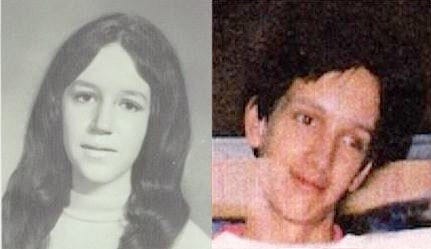
Her name, as far as I can tell, is unique. I had a rich set of identifying facts about her after a few minutes of online search. Because her father had died a few months before, I found an obituary, with a full list of kin that comprised her parents, her siblings, and her nieces and nephews. It enabled me to infer the likely place of her upbringing, which made it easy to authenticate the photos I quickly found at Classmates.com.

Free post
#5
May 2, 2022
Read more

Mirroring Part 1: The Wellisch Letter

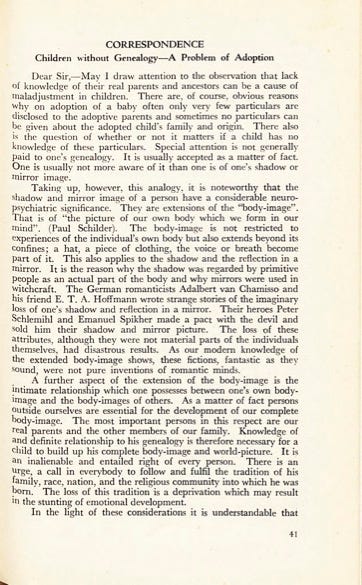
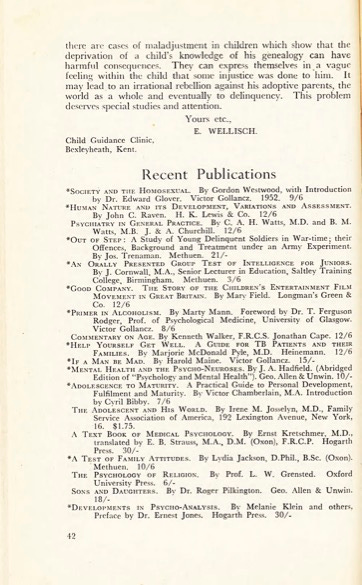
In 1952 the Journal of Mental Health published a letter from the psychiatrist E. Wellisch under the title “Children without Genealogy—A Problem of Adoption.” It subsequently became known as the first warning, in print, of the danger that “genealogical bewilderment” (not Wellisch’s phrase) poses to the psychological well-being of adoptees. Here is the letter; text reproduced below.

Text of the Wellisch Letter

Free post
#4
April 28, 2022
Read more

On Narrating What Happened

It’s a familiar plot conceit: They’ve taken you from your family, your town, possibly even your country. They’ve given you a new life. They’ve erased or sunk in a bureaucrat’s file your former identity, and issued you a new one. There are twists on the conceit:

  • You know they did this, and you know or remember something about your former life, and you had consented to it.

  • You know they did this, but you don’t remember your former life, although you had consented.

  • You don’t remember even that they did this, although you had consented.

This is the stuff of thrillers and spy novels. And then there are the versions where these things happened and you do or don’t remember that they did, except you did not consent. You are an unwilling pawn in someone else’s scheme. That’s the stuff of dystopian novels. And of adoption.

Non-adoptees tend to react in a curious way when an adoptee narrates a life story that involves, if only implicitly, erasing and replacing their original identity: with indifference. Erasure doesn’t generally appear to strike kept people as a loss, a calamity, at all. Separation is another thing: kept people understand that one generally relinquishes a child only in circumstances of crisis. The typical response to separation—the social counterpart to the legal fact of severance—is to find a silver lining: to say that it was “brave” or “deeply loving” or, incredibly, “unselfish” (!) for a parent to give their own child to another family—part of the idea of the adoptee as “blessed.”

Free post
#3
April 20, 2022
Read more

Fourteen Propositions About Adoption

These propositions are grounded in reflection on my experience as someone who was relinquished in a closed, same-race, same-religion domestic adoption in the United States. These propositions suggest, support, and clarify each other. I note many such connections in parentheses. I offer the propositions as empowerment to adoptees, and as advice, corrections, and warnings to kept people.

1. Adoptive parents raise other people’s children.

To be an adoptive parent is to raise, and to have the legal rights of parenthood over, someone else’s child. It might seem odd, or even counterintuitive, to put the point so starkly, but it is a simple statement of fact. The key to understanding it is to remember that an adoptee has a pre-adoption history: a life, however brief, before someone other than the adoptee’s biological parents acquired legal parental rights over them.

Many kept people are accustomed to hearing their birth stories: narratives detailing such incidents as what was happening when their mother went into labor and the adventures or misadventures leading up to their birth, and reminiscences of what impression, as infants, they made upon their parents. Adoptees have birth stories as well, albeit often secret ones. My mother lived in a farmhouse when she was pregnant with me. When I was born, one of her sisters was present, and she was the first person in her family to hold me in her arms. This is the birth story I learned at age 39, shortly after I had identified my birth mother and made contact with her siblings.

Free post
#2
April 12, 2022
Read more

Coming soon

This is This Is Not A Legal Record, a newsletter about Irregularly timed dispatches from my travels in the world of adoption.

Subscribe now

Free post
#1
April 12, 2022
Read more
  Newer archives
Bluesky
Twitter
Facebook
Powered by Buttondown, the easiest way to start and grow your newsletter.