This morning I left my bed, walked down to the kitchen, and brewed a pot of Blue Bottle coffee. The beans were a Father’s Day gift from my sixteen-year-old child. It was a beautiful morning—breezy, sunny, and dry, likely the last such day before a punishing heat wave sets in—and I sat on my porch, solving my array of daily puzzles, thinking about the two men I designate “father,” though only one gets the casual honorific “Dad.” That is my adoptive father. I saw him last week. It was the first time since my wedding a year and a half ago, which ended in a glimpse of him with his arm around my birth mother’s brother’s shoulder: a moment of two timelines meeting in violation of taboo, the social contract, the spirit of the law, and all that is holy.
On the second Sunday in June I was in a plane landing at the Destin-Fort Walton Beach Airport in northwest Florida. I grew up in Fort Walton Beach. Dad moved Mom and me there when I wasn’t quite nine years old. It’s where I grew up; it’s where Mom died, while I was off at college; it’s where Dad remarried and then, two years ago, became a widower again. That’s when his mind began fading. His sisters live in Birmingham, Alabama, where I was born and adopted. They are his caretakers now. They moved him to an assisted-living community after he was discharged from the hospital for treatment for gastric bleeding. He has been there for a little over a month. “I think now is a good time to come see him,” one of his sisters told me.
I left the plane; I fetched my tiny carryon I was required to check; I walked to the rental-car counter. I had requested a compact car, and they gave me a Toyota pickup truck. The weather was beautiful: hot, but fanned by an ocean breeze. I drove over the Mid-Bay Bridge and to a Publix supermarket in Destin. I grabbed a deli sandwich and some snacks. I drove to Henderson Beach State Park on the Gulf of Mexico and joined the long line of cars, crawling smoothly. I entered the bath house, changed into my bathing suit, trudged through the sand to the beach-rental booth, and reserved two chairs and an umbrella. You can never predict how the water will be. Sometimes it will be choked with stinking sargassum. Sometimes a red tide will turn the ocean to poison. This day it was clear and bottle-glass green. It was bathtub warm—maybe worryingly warm, but I decided not to think about it. I waded out and floated under the sun, a speck beneath the bowl of a once again startlingly huge sky. For about three hours I alternated between basking and reading. I had brought fellow adoptee Sandra Steingraber’s memoir, Living Downstream. I was alone, plunging into the comforting atavism of reenacting my early years in Florida when I would spend whole days on the beach by myself, hunting for sand dollars or coquinas or augers or blue crabs, or pretending I was storming Omaha Beach, or teaching myself how to skimboard. Meanwhile, my dad was in his room about ten miles west, wrapped in a tangle of blankets, with a box of uneaten lunch at his bedside. To use a word Sandra suggested to describe my state of mind, I was deep in dissociation.
So many people out there are NOT bitter adoptees, but happy, grateful, well adjusted adults. I’m just sad that you will always make yourself a victim. Such a sad way to waste your time. —X/Twitter user RCTroutman8
Every adoptee who says “I have come out of the fog” means something different by it. What I mean is that I have left behind a conceptual universe of concepts, linkages of concepts, and readymade scripts defining, in a loose sense, the “meaning” of adoption. Having abandoned it so completely I sometimes fail to appreciate how bafflingly foreign my ideas about adoption must seem to many people who have lacked the means, motive, and opportunity to escape that universe.
RCTroutman8 enacts the core Gratitude Script of adoption:
I have about six books on adoption—memoirs and monographs—in various states of unreadness. That is entirely typical. I would like to add a seventh: Florence Fisher’s The Search for Anna Fisher, about her quest to find her birth mother. Florence Fisher died last year: October 1, 2023. Marley Greiner, a cofounder of Bastard Nation, eulogized her, while offering some characteristically sharp observations, here.
Fisher was one of the foremost pioneers in adoptee-rights activism. Before almost anyone else, she identified adoption as a rights crisis for adoptees. For instance, she wrote:
Sealing our records is a violation of the Constitution. We are told the law is protecting the privacy of our natural parents. My mother has the right to privacy from you, but not from me, her baby. She has no right to privacy at the expense of my anonymity.
I echo this regularly when I say that privacy entitles you to withhold from me facts about you, not facts about me. My identity is not something anyone else can claim as theirs.
This post is dedicated to my Aunt Marianne, the only person I know of in my family who has read Derrida.
Last week, from April 4 to 6, I attended the conference of the Alliance for the Study of Adoption and Culture (ASAC), held this time at Brown University, a train ride away (well, two train rides away) from my home near Boston. I left academia thirteen years ago, but I was thrilled to be among scholars and writers and artists, ages spanning at least five decades, who are creating knowledge and art about adoption. And I was delighted to be free of the pressures of "performance," not being a presenter, but only an attendee, there to learn from others and to make friends. I did a lot of both.
Word had gotten out that the 5th was my birthday. My 50th, in fact: right on time, my "Hello, we are the AARP" letter was delivered just a few days earlier. I bonded with the adoptee author, social worker, and activist Susan Harris O'Connor over our shared birthdate. Other participants approached me with gifts. I got a tiny journal, two jars of flavored salt, chocolate and cheese--and books. Brilliant books by adoptee scholars and writers.
It was bittersweet to have no institutional affiliation. I don't often look back regretfully on having ended my long and tortured romance with academic life, but this was a moment when I felt the loss. As much as I admired the scholars presenting their work, I also felt the gentle sting of envy.
On March 15, 2014, I assembled a lasagna. For once, I scarcely thought about the drudgery. I'd bought fresh noodles from Russo's in Watertown, now closed and gone. I'd dirtied most of my pots, bowls, and saucepans from parboiling the noodles, cooking the bechamel, mixing the ricotta, mozzarella, and Parmesan. When I had assembled it, I wrapped it tightly in tinfoil and put it in the refrigerator.
The next morning, exactly ten years ago as I write, I packed a duffel. I took a short walk to a car rental office. I drove back home, fetched my duffel and the lasagna, and began a 380-mile drive due west on Interstate 90: the Mass Turnpike out past Worcester and Springfield and the Berkshires; the state-line crossing and the towering Castleton-on-Hudson Bridge; the northward bend around Albany and onto the westbound New York Thruway past post-industrial cities, woven together by the Mohawk River and the towpath of the Erie Canal; past the Finger Lakes--Otisco, Skaneateles, Owasco, Cayuga, Seneca, Keuka, Canadaigua. All of this was new to me. On the front passenger seat were directions I'd scrawled on a scrap of paper torn from a yellow steno pad. I almost missed the exit. The name of the town I was looking for wasn't on it.
Twenty minutes later I knocked on the apartment door of the woman who had given birth to me thirty-nine years before, whose face I had not seen, whose voice I had not heard, whose hands I had not touched, since I was a newborn baby. Whose identity was an official secret I did not unlock until six months before this moment, right now, when she stood in the doorway, her face smiling in the way I've since become accustomed to seeing as she said, "Hi!"
March 16, 2024 is the tenth anniversary of my face-to-face reunion with my birth mother.
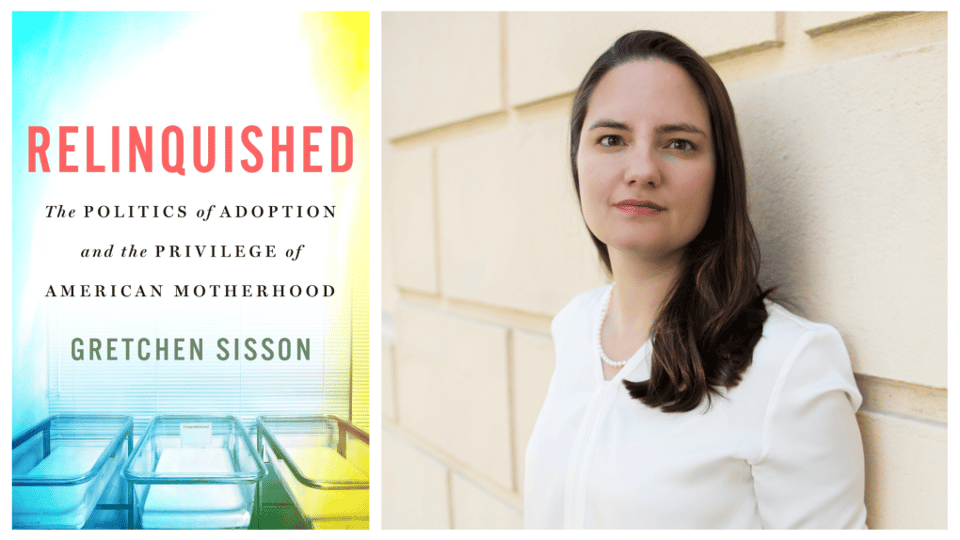
Last week I attended a bookstore event at which Gretchen Sisson discussed her new book Relinquished: The Politics of Adoption and the Privilege of American Motherhood. Sisson is a qualitative sociologist at Advancing New Standards In Reproductive Health (ANSIRH), part of the Department of Obstetrics, Gynecology, and Reproductive Sciences at the University of California, San Francisco. Relinquished, like Ann Fessler's The Girls Who Went Away and Rickie Solinger's Beggars and Choosers, directly confronts the effects of adoption, as a set of legal, economic, and social practices, upon pregnant people who lack the resources and support they need for parenthood. Whereas Fessler's book compiles oral histories of birth mothers from the Baby Scoop period (1945-1974), Sisson foregrounds birth mothers from the first two decades of the 21st century, combining their stories, in their own words, with analysis of the social context in which they relinquished their children for adoption--or as I often prefer to say, lost their children to adoption.
I met Gretchen over coffee in San Francisco in August of 2023, as the galleys were being prepared for publication. (Note: when I refer to her as a personal acquaintance, I will use "Gretchen." When I refer to her as a scholar and researcher, I will use "Sisson.") She shared a PDF of the galleys with me, but as I sheepishly explained to her last week, I had not read them. Oddly (and irrationally), I felt it was an illicit privilege to read the book in advance of publication, even though I had preordered a copy months earlier. I believe I was a bit overawed. Both then and at the book talk, I felt some shock that this person, who had begun to take an interest in adoption policy, practice, and politics while working with teenage mothers during her years as a graduate student in metropolitan Boston, had, without any direct experience of adoption as part of the so-called "triad" (adoptee, birth parent, adoptive parent), recognized the inequity and exploitation on which the private adoption industry rests and had decided to study it systematically.
I mentioned to Gretchen that Relinquished is an excellent title, but that it also pricked my ears as an adoptee. Because as a verbal adjective, the word describes not the women whose stories she relates, but people like me: adoptees. We are the relinquished. In another sense, relinquishing parents are themselves relinquished: relegated, marginalized, generally voiceless in the joyful clamor that attends every new adoption. Gretchen acknowledged all this, but she noted (as she does in the book) that it is adopted and displaced people who have led movements for abolishing adoption as it is currently practiced, and whose voices have helped to guide her work. The book's aim is to present the authentic voices of parents who have lost their children to adoption. In that sense it is not "about" adoptees. But because it illuminates their experiences--the experiences of adopted people's parents, parents like my own birth mother--and because its arguments are a crucial part of the case for reform and abolition of adoption, I regard this book as a landmark in the history of research on adoption, and one of the most valuable scholarly contributions to the struggle for adoptee justice in the entire history of that struggle.
I will shortly be deleting my Substack account altogether. Some of you have been receiving notices from Substack about your subscriptions having lapsed. But since I will not be posting through Substack anymore, you aren't missing anything!
But paid subscribers should know that since I have disconnected Substack from my Stripe account (which handles paid subscriptions), you cannot create, renew, or change paid subscriptions there. Here are some links if you are interested in creating, renewing, or changing a paid subscription:
I am resharing this post for two reasons: I have figured out what was preventing me from sending emails directly from my web domain www.notalegalrecord.net; and I am including the link to Judge Richard Doman's judgment, which you can copy and paste. My newsletter platform inserts so-called "query parameters" (into the links I embed in my posts. Usually they cause no trouble; but with the UK Family Court webpage, the addition of those parameters breaks the link. Technical note: you can always copy the first part of the link, which comes before the question mark, and paste it into a browser window. But my goal is to figure out how to eliminate the query parameters so you don't need to bother. Thank you!
People who come across my posts on adoption often ask me what the alternative should be. There is the constructive version of this question: If the sociolegal practice of adoption were somehow abolished, what should replace it? And there is the hostile version: Would you have infants tossed in dumpsters, or languish in orphanages, or suffer some other horrific fate?
When the hostility is not tactical—misrepresenting my position to cast me in a morally ugly light—it might rest on a misunderstanding. When I talk about adoption, I am talking about a historically specific set of legal, social, and economic practices, pioneered in the United States and widely emulated in other European and Anglophone countries. When I criticize adoption, when I imagine abolishing adoption, I mean this set of practices. I do not mean all forms of long-term custodial care for a child outside their immediate family. "Adoption will always be with us"—yes, in this latter, broad sense. Of course it will. But adoption in the specific form I am concerned with did not exist before the early decades of the 20th century; to say that this will "always be with us" is to ignore the contingency of history. I think of Ursula K. Le Guin's remark about resisting the despair of thinking historical forces are immutable:
We live in capitalism, its power seems inescapable — but then, so did the divine right of kings. Any human power can be resisted and changed by human beings. Resistance and change often begin in art, and very often in our art, the art of words.
Our official understanding of the purpose of separating families is that, regrettable though it may be, it is sometimes necessary for protecting children in parlous circumstances. Indeed, on the official understanding, the best interests of the child are paramount, taking priority over all else. This is codified in the UK Adoption and Children Act 2002:
I just encountered another rocky patch on the journey to independence from Substack. Some of you who pay for your subscriptions might have noticed a payment going out to "corsent.substack.com".
This is not a payment to Substack.
You are seeing this because I set up my Stripe account when I enabled paid subscriptions on Substack, and Stripe gave my account the name "corsent.substack.com" by default. It's purely an identifier, and I can change it. I should have changed it weeks ago! And now I have. Future payments will appear on your statements as "This Is Not A Legal Record."
Adoption has begun to exert a gravitational force in my thinking, bending my mind toward it at surprising moments. I have been thinking lately about our uncritical tendency to accept the idea that ChatGPT, and other chatbots powered by Large Language Models, embody an artificial form of reason, however imperfectly. It's now commonplace to observe that chatbots "hallucinate" facts, events, and things in their answers to the prompts we give them. Earlier this year I asked ChatGPT to tell me about the route that the Middlesex Canal took through the town of Winchester, Massachusetts, where I work. This canal, which ran from Lowell southeast to Boston, predated the Erie, and in some ways served as its more famous successor's model. ChatGPT told a story about the canal that incorporated truths and wild falsehoods in roughly equal measure. My favorite fabulist touch was its mention of a very particular style of truss bridge, which it alleged had been built over a particular river in town and is now listed in the Register of Historic Places. But there was never any such bridge over the river, and there was never any such river in Winchester.
I heard a linguist on public radio remark that some AI researchers object to describing these fabrications as "hallucinations," because to do so is already to grant a kind of sentience to the models that generate them. But these models are obviously not sentient. They are extremely computationally intensive text-prediction machines. Yet we love to be dazzled and fooled. The early pronouncements from software engineers and tech journalists that LLMs are "alive" already look as naive as the screams of terror from early cinemagoers at the looming locomotive seemingly about to barrel out of the screen.
Not only are LLMs not sentient; they handle language in as unmindlike a manner as one can imagine. To produce languagelike strings, ChatGPT was trained on nearly 600 gigabytes of text data--orders of magnitude larger than the corpus to which any human language learner is exposed. We master language on a much slimmer diet of words, and we do something no machine-learning model can do, now (or, I believe, ever): use language creatively. We produce language that is appropriate to never-before-encountered contexts and independent from direct stimulus control. Noam Chomsky called this "the creative aspect of language use" over 60 years ago, and it remains out of reach of what we call Artificial Intelligence.
Chomsky is making the same point still. In an op-ed published in March 2023 he noted that human minds, unlike LLMs, can, "by dint of language, in the words of Wilhelm von Humboldt, can make 'infinite use of finite means,' creating ideas and theories with universal reach." The key to understanding human language, Chomsky believed 70 years ago and still believes today, is identifying and describing the "finite means" by which we produce and understand language in its boundless uses--what he once called Universal Grammar. And Chomsky credits Humboldt, a German polymath and explorer who died in 1846, with the germ of this idea.
Substack’s leadership has made clear that they are happy to allow Nazis to use the Substack platform to coordinate and monetize their hate campaigns. Here is Hamish McKenzie’s justification. Here is Chris Best’s justification. They rest their position on the view that to deplatform Nazis from Substack is to practice censorship. This is simply a confusion.
Substack censors no one by refusing to provide a platform for hate speech. Governments censor speech. Substack is not a government branch, agency, or tribunal; it does not wield the power of the state to suppress speech. Its decisions do not carry the force of law; in banning hate speech it violates no law. The First Amendment prohibits government abridgment of speech. By invoking the notion of censorship, Substack’s leaders show a grossly inflated sense of their own importance. They are feckless, cowardly, and greedy. At best.
I have struggled for a while with remaining on Substack. I have felt duty-bound to honor your commitments to me with a commitment to you. But the situation is now untenable: we see clearly what this platform’s leadership believes, and because I can continue my work elsewhere, I will.
Kim’s tactic is familiar in pro-adoption circles: accuse critics of adoption of trafficking in dangerous “bioessentialist” prejudices about the sacredness of shared DNA. I confronted one particularly odious specimen of this tactic, meeting its vituperation with venom of my own, here:
This Is Not A Legal Record is a reader-supported publication. To receive new posts and support my work, consider becoming a free or paid subscriber.
I’m breaking from my newsletter’s normal focus to share an open letter to the leadership of Substack about its Nazi problem.
Early this year, a reader pledged to pay a subscription to my newsletter if I would authorize payments. I decided to do so, although I will never limit any of my content to paying subscribers. I am grateful to all those who have decided to support my work in this way. I have always intended this newsletter to be a place where I can work out my jumbled overabundance of thoughts about my adoption, and about adoption generally, and (I hope) thereby provide something of use or comfort to other adoptees who, like me, see something deeply morally rotten at the core of this practice everyone is conditioned to celebrate.
For me, the core of adoptee rights and justice is the right to oneself—to one’s identity. I construe this broadly enough to include one’s history: knowledge of one’s familial connections, original culture and community, and (literally life-or-death for many of us), health history. And in recent posts I have explored the connections between the struggle for adoptees’ identities and the struggles of marginalized groups including children and gender nonconforming people.
Therefore, like many other Substack writers, I am alarmed at the popularity of extreme right-wing content on this platform. (Richard Spencer is a Substacker.) I am dismayed at the fact that those of you who are paid subscribers are, in effect, subsidizing the efforts of those who use Substack to coordinate campaigns of hatred. I do not want to pull up stakes—at least, not quite yet. And so I am a signatory to an open letter to the leadership of Substack, demanding an answer to the question: Should Nazis have a home on Substack? If Substack employs any content moderation policies at all, how are they deployed against Nazis? Why is the platform itself willing to promote writers with a documented history of hate speech?
In 2021 the Oxford historian Faisal Devji published an essay, “The Childhood of Politics,” which opens this way:
Children, along with the mentally ill and prisoners in countries like the United States, are the only category of citizens disallowed from having a say in their own futures. That is to say, they are denied access to politics as a practice devoted by definition to making the future.
We keep children out of political life for the same reasons that so-called democracies have kept women and enslaved people and formerly enslaved people and prisoners out of political life. These reasons include “their congenital immaturity, ignorance, dependence on others, vulnerability to outside influence, and inability to own or control property.” But children pose a special problem for politics (and, I would say, the idea of democracy), if politics is about directing our collective effort towards making the future. That is because children “cannot consent to making the very future they are meant to represent.”
This Is Not A Legal Record is a reader-supported publication. To receive new posts and support my work, consider becoming a free or paid subscriber.
New York Times opinion columnist Lydia Polgreen recently wrote about the backlash against the growing acceptance of diverse gender identities, and about abetting children’s wishes to transition away from the gender assigned them at birth. (Here is a gift link.) At the center of these conflicts is the question of what is real and what we know about our own gender identities. How can a child justify their claim that their real or true gender identity does not conform to that assigned to them? Indeed, how can anyone?
Polgreen generalizes the question, and it is her answer that I want to dwell on.
This Is Not A Legal Record is a reader-supported publication. To receive new posts and support my work, consider becoming a free or paid subscriber.
How do we know who we are? This may seem like a profound, philosophical question. The exhortation to know yourself is, after all, one of the most famous and ancient utterances in Western civilization. But it is also an interesting question to ask yourself in a more literal sense. Because what we discover, if we are really honest with ourselves, is that most of the time we know who we are because someone told us.
Our family forms outpace our language.—Judy Osborne, Wisdom for Separated Parents1
When I was preparing for a career teaching and studying philosophy, I was preoccupied with meaning. I wanted to understand how the meanings of words are related to their use. I was guided by the conviction that words do not contain instructions for their application in new circumstances. All sorts of factors mediate the connection between a word’s meaning and the ways we apply it: history, social expectations, our conversation partner’s background knowledge. And meanings are not neutral. When we are debating things that matter deeply to us, and we seem to disagree about what should be said, it isn’t always enough to point out that you and I are using a given word in different senses—even if we are. That meaning is both unstable and contested is familiar to any adoptee who has been told who counts as “real family.”
This Is Not A Legal Record is a reader-supported publication. To receive new posts and support my work, consider becoming a free or paid subscriber.
Adoptees hear that their “real” family consists of the people who chose them, who love them, who raised them. The first time I spoke with my adoptive father about my reunion with my birth mother—years before he met anyone in her family—I casually referred to her as “my mom,” which evoked a shocked reply: “I never thought I’d hear you use that word for anyone but [adoptive mother].” If it were simply a matter of disambiguation, I might have assured him that I was only using “mom” in the sense of “birth mom.” But this would not have helped. Kin words like “mother” and “father” carry emotionally freighted associations that outstrip their meaning in a more narrowly referential sense—even if those words have multiple distinct referential senses, as “mom” clearly does. When the context calls for it, I disambiguate with the phrases “adoptive mom” and “birth mom.” But with adoptive parents like mine, the word “mom” functions as a trophy, or at least an honorific. My adoptive father saw it as a word my adoptive mother was entitled to. Maybe it was by divine dispensation, maybe by dint of her having spent so many years raising me. Probably both.
Betty Jean Lifton, one of our most psychologically penetrating writers on adoption, believed in ghosts. Not “respectable” ghosts, perhaps, who are “unambiguously dead,” but the ghosts that haunt everyone in the so-called “adoption triad:”
These ghosts spring from the depths of the unresolved grief, loss, and trauma that everyone has experienced. They represent the lost babies, the parents who lost them, and the parents who found them. Too dangerous to be allowed into consciousness, they are consigned to a spectral place I call the Ghost Kingdom. Search and reunion is an attempt by adoptees to reconnect with the ghost mother and father, and live the alternate life.1
When I first read Lifton’s writing on the Ghost Kingdom, I wanted to embrace the concept, but I was wary. In childhood and adolescence I did not wish for my biological parents’ return. I did not want—or permit myself to want—to know them. Being raised in a Catholic family that embraced petitionary prayer to Jesus, Mary, and the saints, I was not above praying for things I thought my heart yearned for. I prayed for a particular girl to like me, for example. (She never did.) I did not pray to make the Ghost Kingdom real.
This Is Not A Legal Record is a reader-supported publication. To receive new posts and support my work, consider becoming a free or paid subscriber.
I write about adoption because, having lived the first half of my life without the language to describe it, I now seek adequate words for it. That is my project. But the project is by its nature incompletable, because being adopted is the first fact, the primal fact, about who I am, and self-understanding is never final. And because adoption is, by its nature, absurd.
I write often about those aspects of adoption that are deprivations—loss of original family, loss of original culture and language, loss of history. But there is a pitfall. Whenever adoptees write about what they have lost through adoption, the common reaction is to remind them of what they have gained. This is natural, given that in Western countries people are acculturated into regarding adoption as an act of beneficence—of rescue from circumstances objectively worse. Hence “It’s better than growing up in an orphanage,” among other typical rejoinders. I wrote recently about how difficult it can be make confident comparisons between an adoptee’s actual circumstances and counterfactual circumstances. But since parents who have relinquished their infant children typically did so under constraint of severe hardship, I do not generally challenge the assumption that adoption has historically left many adoptees better off. (I am here leaving aside the question whether it is possible to help pregnant people in crisis overcome those often temporary hardships.)
This Is Not A Legal Record is a reader-supported publication. To receive new posts and support my work, consider becoming a free or paid subscriber.
My writing is primarily about the problems adoption creates for adoptees, the problems that are intrinsic to adoption when practiced as a nonbiological means of creating nuclear families, as it has been since its creation in its modern form 90 years ago. Hence my interest in loss of original family, culture, language, history. And hence the pitfall. Surely the losses are far smaller than the gains of being adopted! Don’t a loving family and a safe household (assuming that the adoptee has these) greatly outweigh the losses?
Unlike you, I don’t see myself as a victim. My adoption was a good thing. I was raised by loving people who could take care of me. I am sure I am better off today than I would have been if my birth mother had not put me up for adoption.
That is a reconstruction, not a literal transcript, of replies occasionally made to my posts about adoption. It is rhetorically potent because it has intuitive common sense on its side. Pregnant people who decide to relinquish do so, in the overwhelming majority of cases, both because their circumstances constrain them to do so and because they judge that their child will be better off in a different family. (Neither of these conditions strictly entails the other. The constraint can be so severe that the relinquishing parent might not know whether their child will in fact be better off; this was even likelier to be true in the Baby Scoop era of closed adoptions and the stigmatization of unmarried pregnancy. And, conversely, a child might be better off in a different family even if the parent isn’t constrained to choose relinquishment. As I like to point out, if adoptees can be made better off in this way, probably your children could have been too.)
This Is Not A Legal Record is a reader-supported publication. To receive new posts and support my work, consider becoming a free or paid subscriber.
It is by no means true of all adoptees that their placements left them better off, in terms of material and social resources, than they might have been otherwise. And in so many cases, particularly with transracial and intercountry adoptions, the very notion of “being better off” that’s presupposed is often saturated with racist assumptions about the inferiority of the child’s social and cultural context. But it is plausibly true of me, having been adopted out of one white family in the USA and into another. Yet even in my case, it is treacherous to draw firm conclusions. Since my birth mother did in fact relinquish me to a Catholic adoption agency, what would I be imagining when I imagine her having kept me? What would have needed to be different? What about her personal circumstances—family support, economic stability, relationship to my biological father, personality characteristics (defiance, stubbornness)—would have had to be otherwise for her to have kept me? These imponderable questions confound any direct comparison of my actual circumstances with counterfactual circumstances. Moreover, it is impossible to know how my birth mother’s circumstances might have changed as a result of deciding not to relinquish. Life, and history, are built out of unforeseeable contingencies. Maybe her situation would have stabilized in certain ways. Maybe my life would have been less financially secure (though I experienced some financial precarity in my actual life growing up). But then, maybe having been raised by my mother and her (i.e., my) blood relatives, my affinities with whom were so evident from the moment I met them, would have conferred advantages I lacked as an adoptee. On balance, which scenario leaves me better off overall? This is unknowable.